


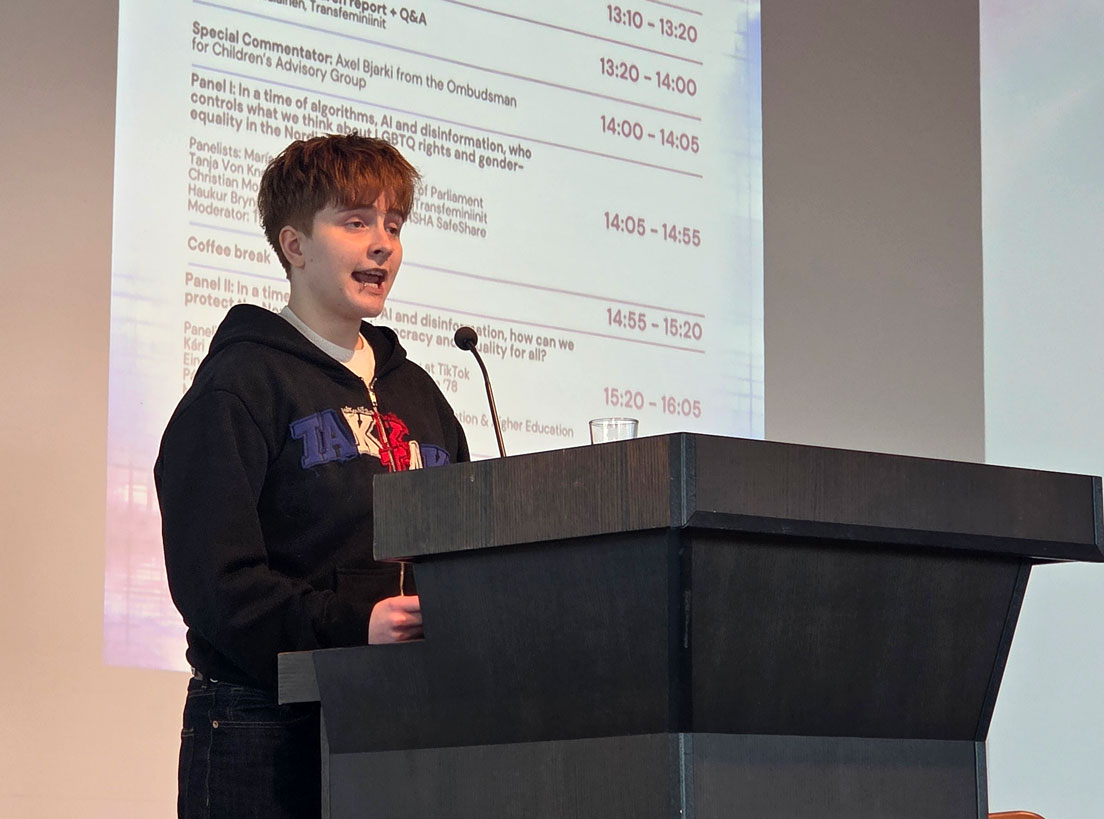
“How many of you in this room have ever had to watch a complete stranger debate whether you have the right to be yourself?” That was how Axel Bjarki, an 18-year-old trans young man, opened his speech at The Algorithm and the Setback: Who Controls What We Think?, a conference held in Reykjavík on 11 November.
The event marked the launch of a new Nordic study of the content TikTok and YouTube show young people about trans people. But the conversation went far beyond the research itself, touching on rising prejudice, the influence of social media on politics and democracy, the responsibilities of technology companies, and what governments can do to protect people's rights online.
Iceland's president, Halla Tómasdóttir, addressed the conference, which also brought together representatives of Samtökin ’78, Nordic researchers, politicians, online safety specialists and TikTok.
Axel Bjarki's speech drew considerable attention. Speaking from personal experience, he described what it means to grow up in a world where the existence of trans people is constantly treated as a subject for debate, and challenged TikTok over the material its platform puts in front of children and teenagers.
Nordic research: prejudice disguised as debate
The conference was organised to present Hate Disguised as Debate: Trans-Related Content in the Feeds of Nordic Youth, a study carried out by NORDREF, the Finnish organisation Transfeminiinit and Ofbeldisforvarnaskólinn, in cooperation with partners including Samtökin ’78.
Nelly Ruotsalainen, one of the three researchers, presented the findings and explained how the study was conducted. The idea grew partly out of earlier research showing how social platforms can quickly begin serving boys more and more misogynistic and extremist material. The researchers wanted to know whether similar patterns appeared in content about LGBT+ people, particularly trans people.
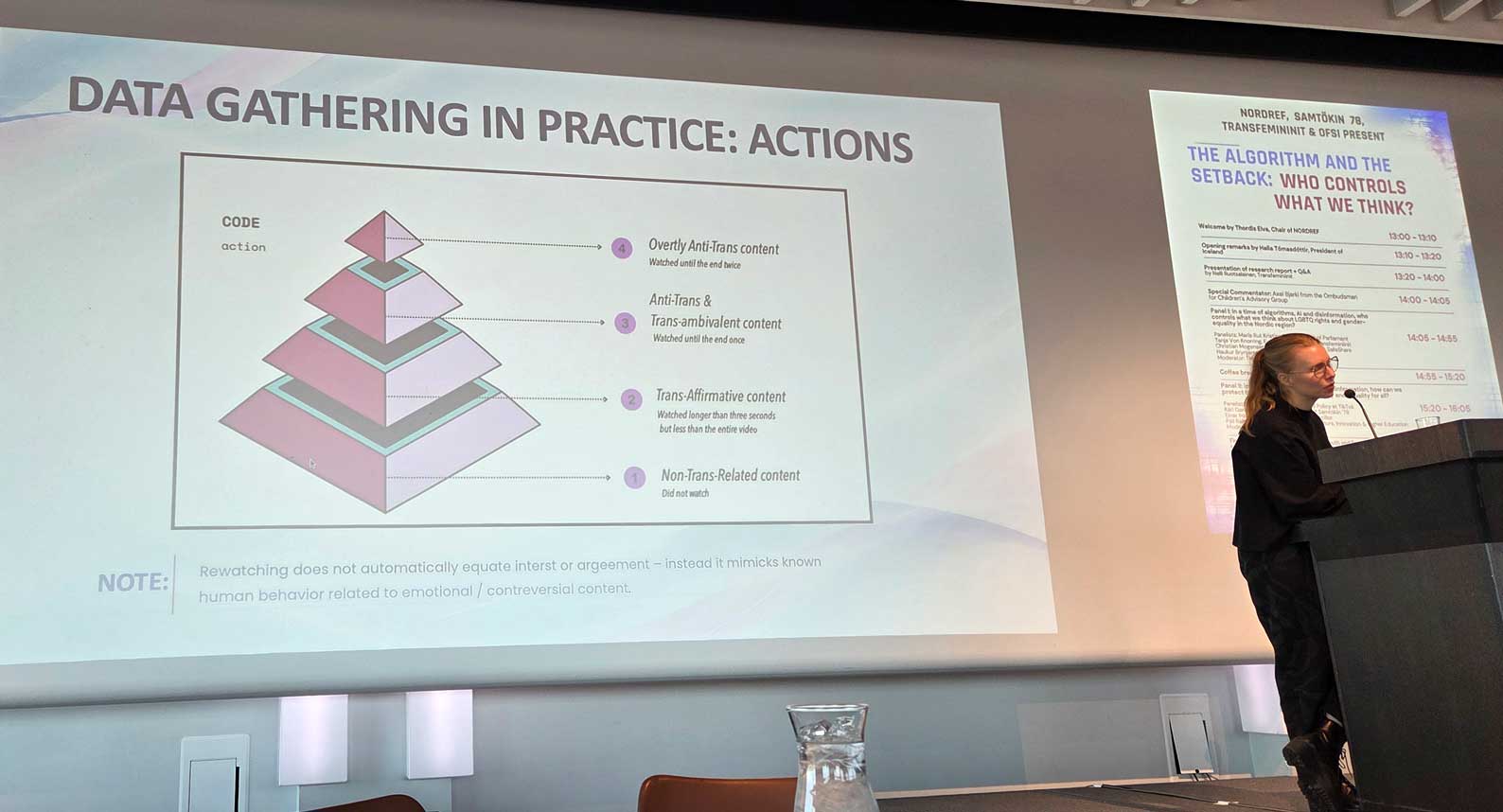
They created 12 new TikTok and YouTube accounts in Finland, Sweden and Iceland, registering them as belonging to 15-year-olds. The fictional users were given interests in either Harry Potter or gaming. The team then tracked how the videos they were shown changed after particular searches and viewing behaviour.
In total, the researchers examined and classified 5,406 videos.
Some of the findings were encouraging. More than 70% of the trans-related content they encountered was supportive, including educational videos, personal accounts and trans creators talking about their lives. The research revealed an active and diverse online community that could offer young people support and help them find others with similar experiences.
But nearly 30% of the trans-related content was either hostile or classified as ambivalent. What stood out was the way prejudice was presented, often in videos that appeared to be ordinary interviews, street conversations or discussions in which people were simply exchanging views.
For example, a doctor with expertise in trans healthcare might be placed opposite someone questioning trans people's rights, with the two positions presented as equally valid sides of a debate. The researchers warned that this format can turn people's fundamental rights into a supposedly open question while giving the appearance of neutral discussion.
TikTok responded much faster than YouTube
A clear difference emerged between the two platforms. Once users searched for trans-related subjects, TikTok began showing them more videos on the topic much faster than YouTube did. The change was particularly noticeable after searches for trans kids.
That is not necessarily a bad thing. The same algorithms can direct young people towards useful information and positive role models. Problems arise, however, when they repeatedly serve material that provokes fear, anger or other strong emotions.
The researchers pointed out that simply watching a video for longer can influence what appears next. An algorithm cannot necessarily tell whether someone keeps watching because they agree with a video or because they are shocked by it.
Searches for J. K. Rowling, the author of the Harry Potter books, could also lead users to material questioning trans people's rights. Comparable searches for gaming personality PewDiePie did not produce the same pattern.
The study did not, however, support the claim sometimes made by opponents of trans rights that social media platforms routinely push trans-related content on users who have shown no interest in it.
Important limitations to the findings
Nelly was open about the limitations of the research. There were only 12 accounts, and although they were registered as belonging to 15-year-olds, adults operated them. The researchers also spent longer watching videos they considered hostile or contentious, sometimes watching them twice, to mimic how people can linger on material that provokes a strong emotional response.
The phones used in the study had previously been display devices at Icelandic telecoms company Nova and had been reset to factory settings. Nelly said the researchers could not be sure whether any data had remained on them. They also used VPN connections so that, within each country, their internet traffic appeared to come from somewhere other than their own home networks. She said she did not know whether either of those technical factors had affected the data collection.
Searches were carried out in English, so the material collected largely reflected English-language conversations on the platforms, including disputes over trans rights in the United States and Britain.
During the questions afterwards, it also emerged that one Icelandic TikTok account had produced a large share of the hostile material identified on that platform. The results therefore cannot establish that young people in Iceland generally encounter more such content than their counterparts in the other countries.
Nelly described the research as a pilot study showing how quickly algorithms can respond to users' behaviour. She hoped it would help secure funding for more extensive research, with larger datasets from which firmer conclusions could be drawn.
President Halla Tómasdóttir: empathy must not be lost
President Halla Tómasdóttir began her address with something that might not immediately come to mind in a discussion about technology and artificial intelligence: empathy.
Humanity has prospered, she said, not because we are the strongest or fastest species, but because we can cooperate, trust one another and care for each other.
Those strengths may be undermined when the technologies shaping our relationships are designed to capture and hold our attention for as long as possible. Social media companies benefit financially when people keep watching, even when the content they see fuels anger, fear and division.
The president said she hoped the companies had not deliberately designed their systems to divide society. Even so, their business models could produce precisely that outcome, because they reward whatever keeps people engaged, regardless of the wider consequences.
Children, she said, are growing up in two worlds. In one, societies have spent generations building laws, rules and institutions to protect them. In the other, the digital world, international technology companies have enormous influence over what children see and experience.
It is no longer enough, in her view, to ask how many hours children spend in front of screens. What matters more is how their digital environment shapes their attention, their sense of self, their attitudes towards others and their understanding of society.
Halla linked those concerns directly to the Nordic study. Although it focused on trans people, its implications went far beyond any single minority group. If technology can make prejudice and hostility seem like an ordinary part of public conversation, anyone could eventually be affected.
She stressed that democratic societies must allow difficult questions to be discussed and people to disagree. But there is a difference between debating ideas and questioning another person's human rights or humanity.
The president also recalled the 1986 Reykjavík summit between Ronald Reagan and Mikhail Gorbachev. That meeting had demonstrated that even superpowers could come together and seek to change a course that seemed inevitable. Today, she argued, a comparable international effort is needed to ensure that AI and other emerging technologies serve humanity rather than undermine the bonds holding societies together.
Governments needed to act faster, she warned. Society had already been too slow to recognise the consequences of social media, and it could not afford to repeat that mistake with artificial intelligence.
Axel Bjarki: “This is our reality”
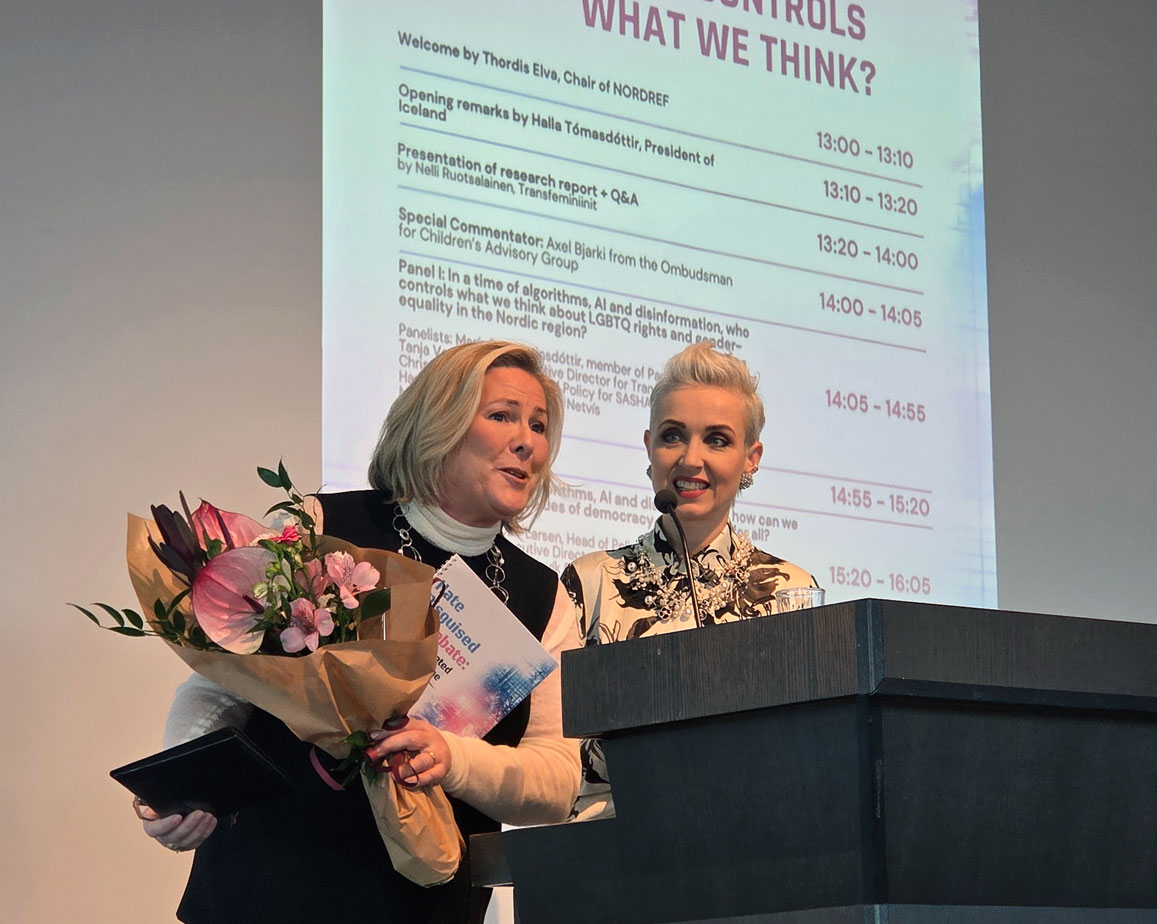
Axel Bjarki's speech drew considerable attention. The 18-year-old trans young man spoke as a representative of the advisory group to Iceland's Ombudsman for Children.
He began by asking how many people in the room had ever had to watch strangers debate whether they had the right to be themselves. For many trans children and teenagers, he said, that was not a hypothetical situation but something they encountered whenever they opened social media.
He described watching hundreds of videos in which his very existence was debated, as well as receiving hateful messages and threats because of who he is. What shocked him was that society had reached the point where a research study was needed to demonstrate how normal it had become to treat trans people's lives as a debate.
“But for me and many other young trans people, these aren't just numbers. This is our reality,” Axel told the audience.
He welcomed the finding that most trans-related content examined in the study was supportive. But around 30% was still negative towards trans people or presented their rights as open to debate. When people's human rights, safety and dignity were at stake, that was far too high a proportion.
He asked the audience to imagine a 13-year-old only beginning to realise they might be trans. Perhaps the child had not yet told their parents or friends and opened TikTok hoping to find information or someone who understood.
Instead, they might see adults arguing about whether people like them should be allowed to be themselves. Then another video would appear, followed by another.
What does it do to a child's sense of self, Axel asked, to hear over and over that people like them are a problem society needs to solve?
He reminded the audience that the damage does not stop with trans children. Other young viewers see the videos too. When celebrities, influencers and politicians describe trans people as a problem, children may begin to believe there is something wrong with being trans.
“No one is born transphobic. Transphobia is learned,” Axel said. And if children can be taught to fear difference, he added, they can also be taught understanding and respect.
That requires education, not only for children but for adults as well. Children cannot be expected to respect others if the adults around them fail to set that example.
A direct challenge to TikTok
Axel then addressed TikTok's representatives directly, asking what the company would do when research showed that accounts registered to 15-year-olds were being shown content questioning a minority group's rights.
Why not label videos containing verified misinformation about trans people and provide reliable information alongside them, he asked? Why not reduce the reach of hateful and misleading material instead of allowing the algorithm to amplify it?
Children looking for information about gender identity should find education and support, not an endless series of political arguments over their rights.
Axel said he understood that nobody could, or should, control everyone's opinions on the internet. But there was a crucial difference between allowing people to express an opinion and having an algorithm repeatedly push it towards children.
He also called for simpler ways to report hateful content and for those reports to be taken seriously.
His appeal was not limited to TikTok. Politicians, influencers and everyone who claimed to support trans people needed to show that support through their actions.
It was easy to call yourself an ally when everyone around you agreed. But what happened when someone made a transphobic remark at the dinner table, at work, in a comment section or from a political podium? Would people speak up then?
Axel said he did not want the next generation of trans children to endure what he had experienced.
He ended with a message to the adults in the room:
“Trans children should not have to be brave just to be themselves. It's time for the adults to show some courage and stand up for them.”
Who decides what 15-year-olds see online?
The first panel discussion considered who really shapes young people's ideas about gender identity and LGBT+ rights.
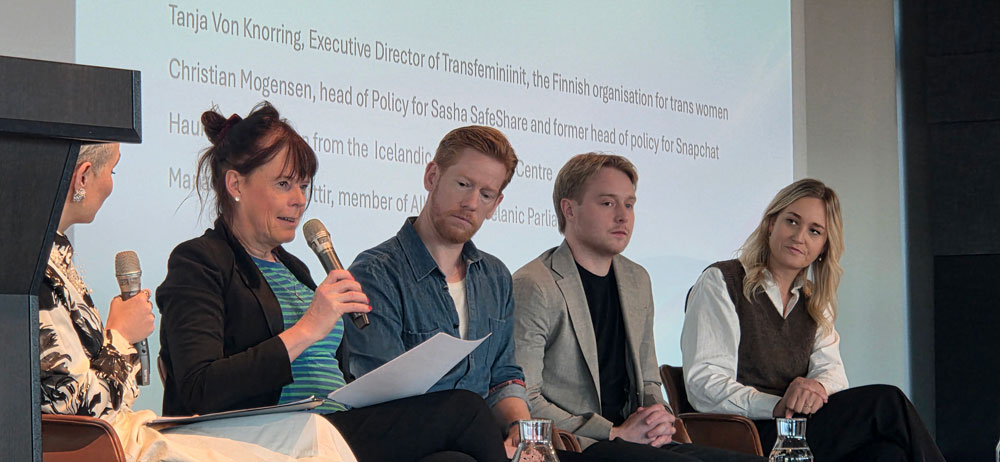
The speakers were Tanja von Knorring, executive director of Finland's Transfeminiinit; Christian Mogensen of SASHA SafeShare, formerly head of policy at Snapchat; Haukur Brynjarsson, who works in online safety education; and Icelandic MP María Rut Kristinsdóttir.
Tanja said the findings had not surprised her. Her work monitoring online hate had already shown how social platforms influence public debate and help spread prejudice. Behind the algorithms, she noted, are global companies with a financial interest in keeping users on their services for as long as possible, while the public has very little insight into how decisions about the reach of content are made.
Christian Mogensen, drawing on his experience inside Snapchat, agreed that the companies' commercial interests mattered. But he argued that the responsibility did not stop with algorithms: it was also necessary to look at the people producing content, some of whom deliberately exploit loopholes in platform rules to spread prejudice without openly breaking them.
Rather than directly declaring that trans people should be denied their rights, someone could package the same idea as an innocent question or an open debate. Such videos may spread widely because they provoke strong reactions, while the algorithms do not necessarily distinguish between comments supporting the content and comments condemning it.
Christian doubted that the platforms could resolve the problem simply by continually rewriting their own rules, because people would always try to push right up against the boundaries. He argued instead that users should have much greater control over what appeared in their feeds, with consent and the ability to reject certain content built more firmly into how social media works.
When online prejudice enters the classroom
María Rut Kristinsdóttir recalled her years working in LGBT+ education in schools, where attitudes had long been largely positive. Around 2020 and 2021, however, she and her colleagues began hearing questions and comments that echoed anti-trans narratives circulating on international social media.
When they asked students where those ideas came from, many said they regularly saw similar material online.
María Rut also spoke about her own experience as a parent. Looking at the content appearing on her son's social media made her realise just how different the online worlds of children and adults could be. While her own feed contained such things as household tips and health-related material, his showed a very different mix, including arguments about gender and gender identity.
Haukur Brynjarsson described similar experiences in online safety education. Some young people said they encountered hateful material every day and had become so accustomed to it that they barely reacted. He also heard some boys and young men insist on their right to say whatever they wanted online, regardless of whether it hurt others.
What happens to a generation growing up with a constant stream of hostile content in its pockets, even in the privacy of its bedrooms? Education and critical thinking could help, Haukur said, but they were no magic solution, particularly when adults themselves often struggled to recognise how social media could influence them.
What is the DSA, and why does it matter for Iceland?
One subject came up repeatedly throughout the conference: the DSA.
The Digital Services Act is European Union legislation governing digital services. It became fully applicable across the EU in February 2024.
The rules cover various kinds of online services, with particularly demanding obligations placed on the biggest social platforms, including TikTok, Facebook, Instagram and YouTube.
The point is not to ban every controversial opinion or allow governments to dictate what people may think. Rather, companies must take responsibility for how their services are designed, the risks they create and what they do when things go wrong.
Major platforms must, for instance, assess whether their services could harm children, contribute to the spread of illegal content, affect fundamental rights or undermine democratic debate. They are then required to take meaningful steps to reduce those risks.
They also face greater transparency obligations concerning their algorithms, independent scrutiny and researcher access. Users must receive clearer explanations when their content is removed or restricted, and have opportunities to challenge those decisions.
The DSA therefore seeks greater accountability while also protecting freedom of expression. In the most serious cases, breaches can lead to fines of up to 6% of a company's annual worldwide turnover.
Why has Iceland not implemented it?
Although the rules have applied in the EU since 2024, they had not yet been incorporated into the European Economic Area (EEA) Agreement at the time of the conference and had therefore not been implemented in Iceland.
Several speakers criticised the delay.
MP María Rut Kristinsdóttir said she had looked into the status of the legislation ahead of the conference and had already begun asking questions about its progress. She intended to push for faster implementation, while recognising that Iceland would need to work through the EEA process with its partner countries.
In the second panel, Páll Rafnar Þorsteinsson of Iceland's Ministry of Culture, Innovation and Higher Education also stressed the need to bring the rules into force. Icelandic authorities, he said, still lacked important legal tools to scrutinise social media companies and hold them accountable.
Legislation alone would not be enough. Independent media also needed support, while media literacy, information literacy and critical thinking should be strengthened, including in teacher education.
The European Commission has already challenged TikTok
Just five days before the conference, on 6 November, the European Commission published preliminary findings indicating that TikTok had failed to meet obligations under the DSA.
The concerns centred on how TikTok's algorithm can draw users deeper and deeper into a particular type of content, a phenomenon often described as a rabbit hole. When someone watches or engages with videos on one topic, the platform may begin serving them more and more of the same.
The Commission was concerned about how this could affect people vulnerable to material involving mental health, body image or isolation. In particular, it questioned whether TikTok gave so much weight to how long a user watched a video that this could override the user's wish to see less of that kind of content.
It considered that TikTok needed to change aspects of how videos were selected for users and give people greater control over their feeds. These were preliminary findings, however, and TikTok had the right to respond before any final decision.
The concern was strikingly similar to the one raised by the Nordic researchers: a person may end up seeing more and more content simply because they watched it in fear, anger or disbelief, not because they ever wanted more of it.
Can the Nordic countries defend equality and democracy?
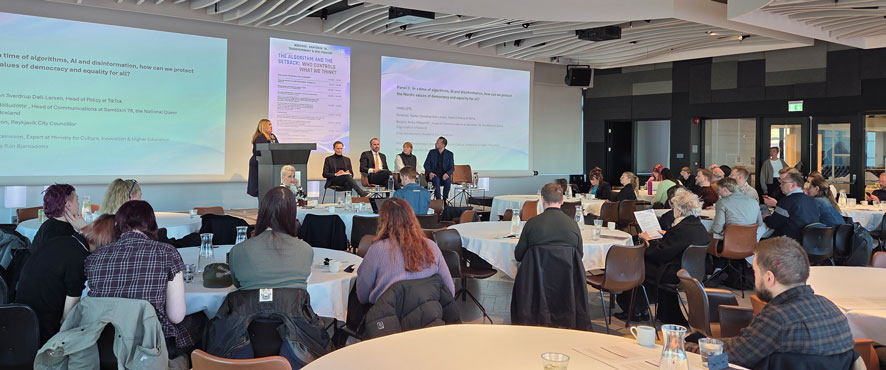
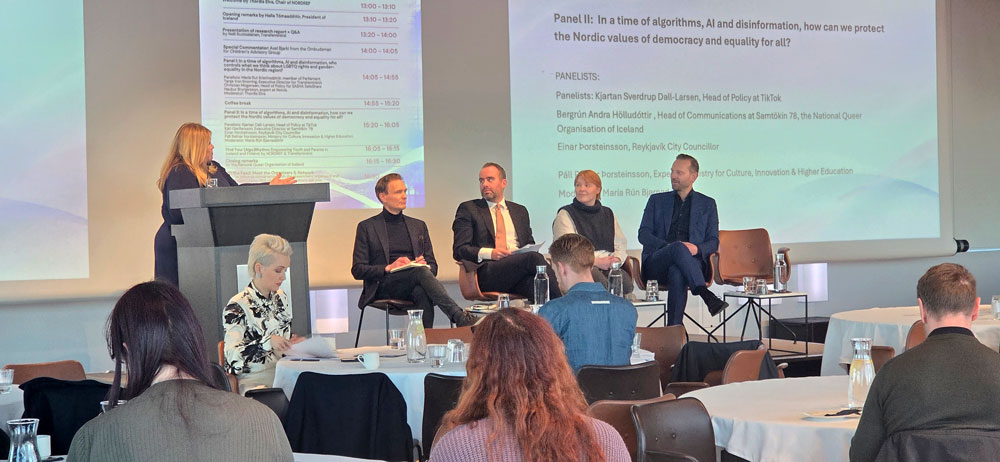
The second panel, moderated by NORDREF co-founder María Rún Bjarnadóttir, asked whether Nordic societies were strong enough to withstand social media's influence on public debate.
Joining her were Kjartan Sverdrup, who handles public policy and government relations for TikTok in Norway and Iceland; Bergrún Andradóttir of Samtökin ’78; Reykjavík city councillor Einar Þorsteinsson; and Páll Rafnar Þorsteinsson.
Páll Rafnar argued that the Nordic countries had important strengths: robust institutions, a strong commitment to human rights and a long tradition of resolving disputes through dialogue and compromise. But those strengths could be eroded. When people became afraid to take part in public debate because of the attacks they might face, the loss was not only personal; democracy itself suffered.
Einar Þorsteinsson observed that people talked endlessly about how artificial intelligence would change the future while overlooking the fact that AI had already been shaping lives through social media for the past ten to fifteen years. The content people saw online affected their interests, attitudes and even their moods, and those influences had already changed politics and voting behaviour.
In his view, social media encouraged polarisation because angry, provocative material attracted more attention than measured discussion. That made it harder for politicians to reach the compromises on which democratic societies depend.
Bergrún Andradóttir was less convinced that the Nordic countries were as well placed as they sometimes liked to believe. Iceland may rank highly in international comparisons of equality, she said, but that success was not necessarily felt by people who fell outside conventional social norms. LGBT+ people continued to experience prejudice and harassment despite the progress already made.
She recalled research documenting a rise in online hate and the growing hostility that Samtökin ’78 had encountered, particularly around Reykjavík Pride.
Social platforms were not solely to blame, she argued. Politicians and others in positions of power also bore responsibility when they spoke disparagingly about minorities. Social media could then amplify those messages and turn prejudice into a powerful political tool.
How did TikTok respond to Axel Bjarki?
Kjartan Sverdrup agreed that technology companies carried considerable responsibility, although he also wanted to highlight the positive role social media could play. In Norway, he noted, news organisations and the public broadcaster were among the most popular accounts on TikTok, helping them reach audiences who might otherwise be less likely to follow traditional news.
When the discussion turned to hostile material about trans people, Kjartan addressed Axel Bjarki directly, saying he was deeply sorry that Axel had experienced such hatred on the platform. He described the study as an important contribution to TikTok's ongoing work and acknowledged that the company did not always succeed in preventing harmful material from spreading.
He also explained that TikTok had more options than simply removing a video or leaving it untouched.
Limiting a video's reach without deleting it
Depending on the nature and context of the content, Kjartan said, TikTok could remove a video, ban an account or restrict certain material by age. It could also prevent a video from appearing in For You, the personalised stream of clips TikTok selects automatically for each user.
That last option is particularly relevant to the research and to Axel's demands.
A video may remain available to someone who searches for it, while TikTok stops proactively placing it in other users' feeds. In other words, the platform can sharply reduce the reach of material without deleting it entirely.
Kjartan gave an example from Norway involving parents using a ghost filter on their phones to frighten their children. The parents sent the children into a bathroom, told them to face the phone's camera and say “Hi Barbara”, and a ghost then suddenly appeared behind them on the screen. The frightened reactions were recorded and shared on social media.
Kjartan condemned the parents' behaviour, but said the platforms also had a responsibility not to spread such videos unchecked. TikTok had therefore made the content ineligible for automatic recommendation and removed the worst examples.
This showed that platforms did not always have to choose between banning everything and allowing unrestricted distribution.
It was precisely the distinction Axel had raised: freedom of expression does not mean that social media companies must actively promote every piece of content to as many people as possible, especially when children are involved.
Almost 90,000 videos removed in Iceland
Kjartan also shared figures on TikTok's enforcement of its community rules in Iceland.
He said the figures covered the period from 25 January 2025 to September 2026.
During that period, TikTok had removed 89,649 videos in Iceland, including 88,125 taken down automatically using AI before any user saw them.
Of the removals, he cited 1,088 for hate speech or hateful behaviour, 804 for extremism and 11,825 under youth and minor safety rules, including bullying and harassment.
TikTok had also banned 29,494 accounts, 8,411 of them because the users were suspected of being under 13.
Kjartan said the company also had people able to review Icelandic-language content and comments and intervene when its rules were breached, although it could not catch everything that should be removed.
The figures offer some indication of the scale of moderation, but they do not show how many videos targeting trans people were removed, or how much such material remained in circulation.
Will TikTok change its algorithm?
When Einar Þorsteinsson asked whether the study would lead TikTok to change its algorithm, Kjartan joked that he would return to his hotel and flip a switch.
More seriously, he said he would bring the findings back to the company and that studies like this, together with public discussion and pressure, were important in improving how the platform operated.
That was not a promise to make any particular change.
Nor did Kjartan answer all of Axel's proposals directly. He did not, for example, say whether TikTok intended to label misinformation about trans people with educational material or change the information children saw when searching for gender identity topics.
He did, however, confirm that TikTok already has technical ways to limit the reach of harmful content without necessarily removing it altogether.
The question, then, is not simply what TikTok is capable of doing, but when and how it chooses to use those tools.
What about threats and harassment?
Towards the end of the discussion, Kjartan was asked about serious online harassment and the responsibility of platforms when users receive threats or are subjected to other potentially criminal conduct.
He said TikTok cooperated with Icelandic police and could preserve IP addresses and other information relevant to criminal investigations.
The company was not outside the reach of all laws simply because Iceland had not implemented the DSA.
Kjartan also argued that reducing harmful content was in TikTok's own interest. If a platform became overwhelmed by such material, users would eventually lose interest and the business would suffer.
But a question from the audience pointed to an uncomfortable contradiction: social media revenues depend heavily on user attention, while content that provokes anger and strong reactions can keep people engaged for longer. That raises the question of whether the companies have a sufficient financial incentive to change their systems fundamentally.
Social media can also be a lifeline
Despite the many warnings about social media, not everyone agreed that stricter age limits or bans were necessarily the best way forward.
Bergrún Andradóttir of Samtökin ’78 reminded the audience that social media can be a lifeline for LGBT+ young people, particularly those living in rural areas or struggling to find people with similar experiences nearby.
For some, the internet is where they first discover that they are not alone, that others feel as they do, and that there is a community where they belong. That must not be forgotten when discussing restrictions on children's access to social platforms.
Bergrún also spoke about Reykjavík's Queer Youth Centre, something she wished had existed when she was growing up. Ideally, she said, all youth centres should be welcoming and safe places for LGBT+ young people.
Einar Þorsteinsson put greater emphasis on the dangers of social media for children, including bullying, harassment and threats that could follow them through school and into their homes.
He argued that parents, teachers and local authorities needed to take the issue more seriously, including through clearer rules on phone use at school and better enforcement of platform age limits.
The discussion also made clear that age restrictions alone would not solve the problem. Kjartan pointed out that children and their parents often inhabit very different digital worlds, making open conversations about what young people see and experience online all the more important.
Teachers need support too
Questions from the audience drew attention to the role of schools in protecting democratic values, human rights and critical thinking.
A teachers' representative noted that schools were required by law to teach equality and human rights, yet teachers could face attacks or accusations of indoctrination when they discussed trans issues or other contentious social questions.
Bergrún agreed that such pressure must not be allowed to push LGBT+ education out of schools. Children needed opportunities to learn about the diversity of society, and teachers needed to know they would be supported in addressing those subjects.
Páll Rafnar placed particular emphasis on helping children and teenagers assess information critically. Those skills belonged not only in primary and secondary education but also in the training of teachers themselves.
From research to action
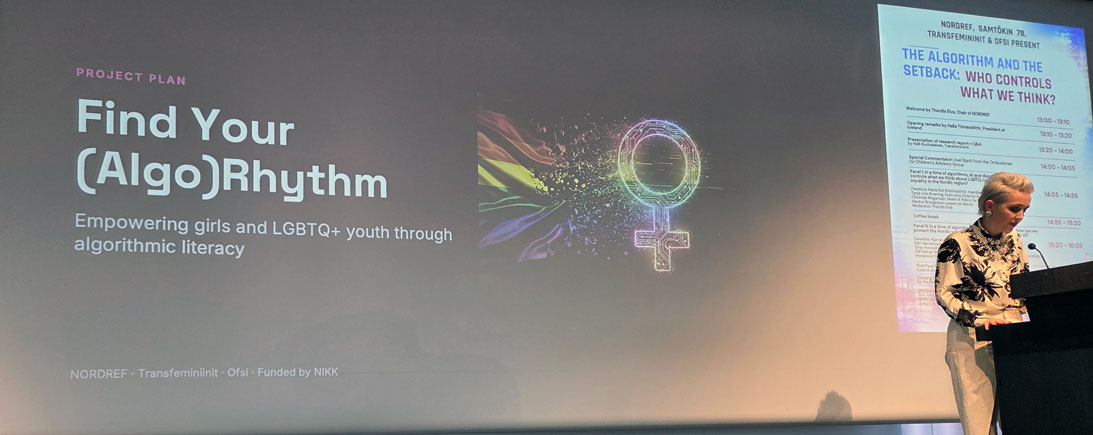
The conference ended with a presentation of Find Your (Algo)Rhythm, a follow-up project building on the study's findings.
Its aim is to help young people, parents and teachers understand more clearly how social media algorithms work and how they can influence what appears on their screens.
Among other things, the project will explain how users can reset their recommendations, clear or change their viewing histories, and make better use of existing settings to gain more control over their online experience.
Pilot workshops are planned from January to May 2027, including six for young people and three for parents in Iceland, alongside comparable sessions in Finland. Educational materials are being developed in Icelandic, Finnish, Swedish and English.
The organisers hope this will be a starting point for bringing similar education to more schools, parents and young people in the years ahead.
Tanja von Knorring, executive director of Transfeminiinit, delivered the closing remarks. Although the conference had explored many shortcomings of social media, she said, it was also worth acknowledging where companies had done better. In a Finnish monitoring project examining how platforms responded to reports of hateful content, TikTok had performed better than the other services reviewed.
But much more remained to be done. Research, discussion and education were important, yet they would achieve little unless they led to change.
Axel Bjarki had made the same point earlier in the day. For children growing up with their very existence constantly turned into a political argument, it is not enough for adults to discuss the problem and agree that something ought to be done.
They have to do it.
Further reading: Hate Disguised as Debate – full research report (PDF) · The EU Digital Services Act · European Commission preliminary findings on TikTok, 6 November 2026

